
METHODOLOGY
People ask me where the idea for Coalition Selling came from. The honest answer is that it did not arrive all at once. It developed over two decades inside enterprise sales organizations at Oracle, Salesforce, and Workday, watching how large customer decisions actually got made.
Where Coalition Selling came from
Use the machine
At Oracle, I started as a direct seller and later moved into an overlap role supporting a broad set of enterprise sales teams. Experienced reps, complex deals, but the world they were operating in was mostly Oracle's own.
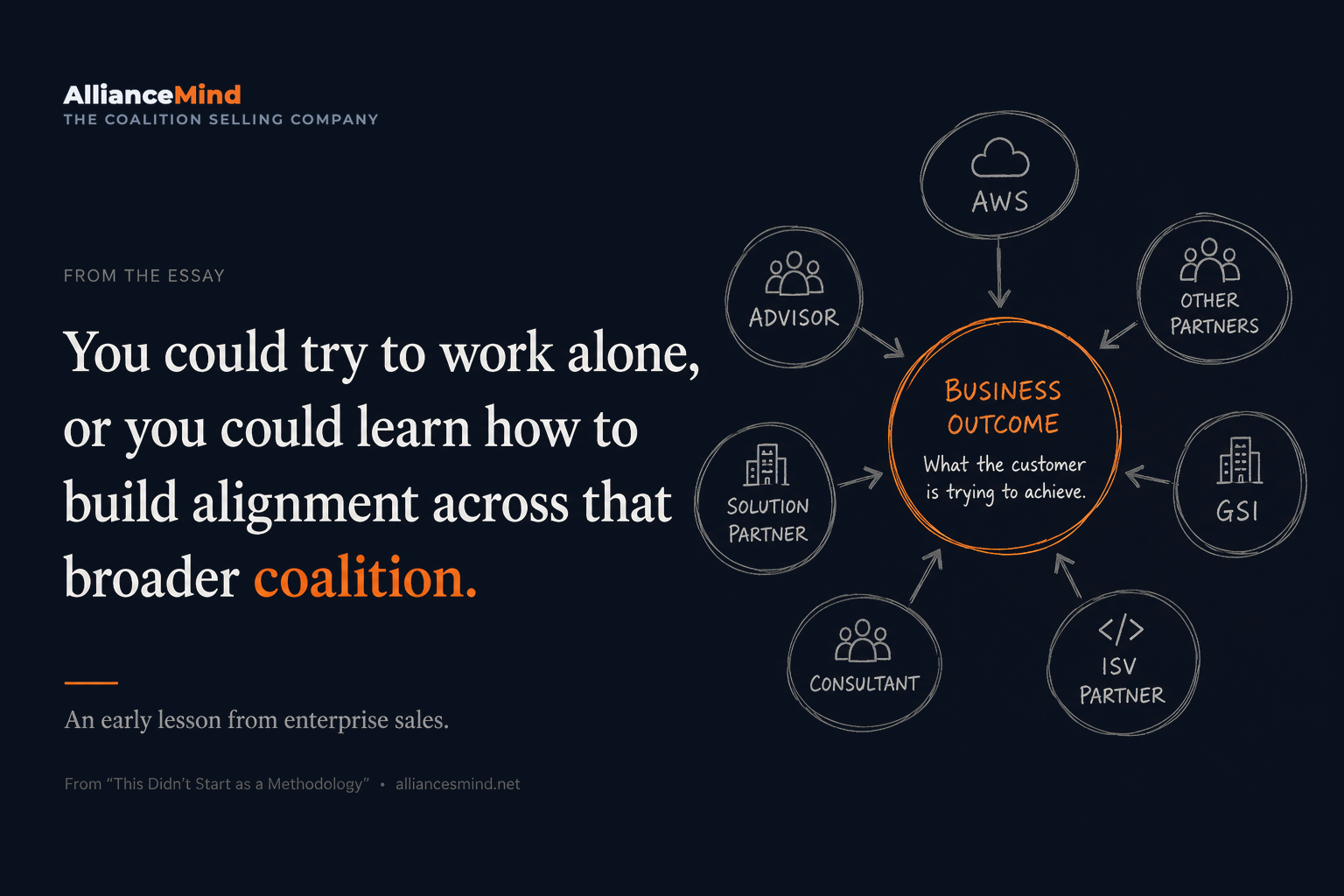
Oracle had enormous depth. Executives, specialists, technical teams, partners, industry experts, customer relationships that went back decades. Multiple Oracle sales organizations were often chasing the same customer at the same time. You could try to work alone, or you could learn how to build alignment across that broader internal coalition.
The reps who figured that out were almost always the most successful. Looking back, that was one of the earliest foundations for what eventually became Coalition Selling.
The deal stopped belonging to the rep
As Oracle moved deeper into the cloud market, I started noticing something else. Large systems integrators and external ecosystem relationships were influencing customer strategy more than most traditional sales motions fully recognized.
At Salesforce, that dynamic accelerated. Customers were not simply buying software anymore. They were investing in broader transformation initiatives shaped by consultants, implementation partners, executive stakeholders, and cloud platforms.
But many sales motions still operated as if the account executive controlled the opportunity from the center. Increasingly, that just was not true.
Those experiences gave me a specific lens on all of this. I have always viewed ecosystem strategy through the realities of enterprise selling and field execution. If something does not help sales teams create alignment, improve customer conversations, reduce complexity, or move important deals forward, eventually it becomes theoretical.
That is probably why I have never seen partnerships as a side conversation disconnected from sales execution.
The methodology became operational
At Workday, I had the chance to explore these ideas much more deeply alongside sales leader Matt Lovell, who was seeing the same patterns. More importantly, Matt had the operational credibility and leadership influence to turn the thinking into actual field execution.
By then, enterprise selling had become dramatically more interconnected. Large opportunities involved cloud providers, partners, marketplaces, consultants, executive sponsors, and customer transformation initiatives, all influencing the same deal simultaneously. The most successful opportunities looked less like traditional vendor sales cycles and more like coordinated coalitions aligned around customer outcomes.
Meanwhile, most organizations were still operating in silos. Sales, partners, cloud teams, consultants, executives, all trying to help, often without anything coordinating them. That gap became impossible to ignore.
Sheets before platforms
As the patterns got more visible, I started building primitive tools in Google Sheets to help teams visualize account overlap, partner influence, and coalition opportunities. Looking back, they were rough early versions of what platforms like Crossbeam and PartnerTap eventually formalized.
What surprised me was not the tooling. It was how fast field teams adopted it once they could actually see the broader ecosystem dynamics around an account. The problem was real.
What Coalition Selling is
Coalition Selling did not start as an attempt to invent another sales methodology. It started as an effort to better understand and help navigate a buying environment that had become far more interconnected, coalition-driven, and operationally complex than most companies fully recognized.
Most sales teams are working under real pressure right now. More stakeholders, more noise, more tools, more expectations, more complexity around every deal that matters. A lot of experienced operators are seeing the same shift, even when they describe it differently.
Whether companies are willing to admit it or not, buying changed. And the deals that get won now are the ones where someone figured out how to align a coalition around what the customer actually needs.
See where your coalition gaps are
The Coalition Selling Readiness Assessment scores your team across seven dimensions. You get a benchmarked score and a one page diagnostic on where revenue is leaking.