

Review the Role of the CCM before reviewing this material
Details can be found here.
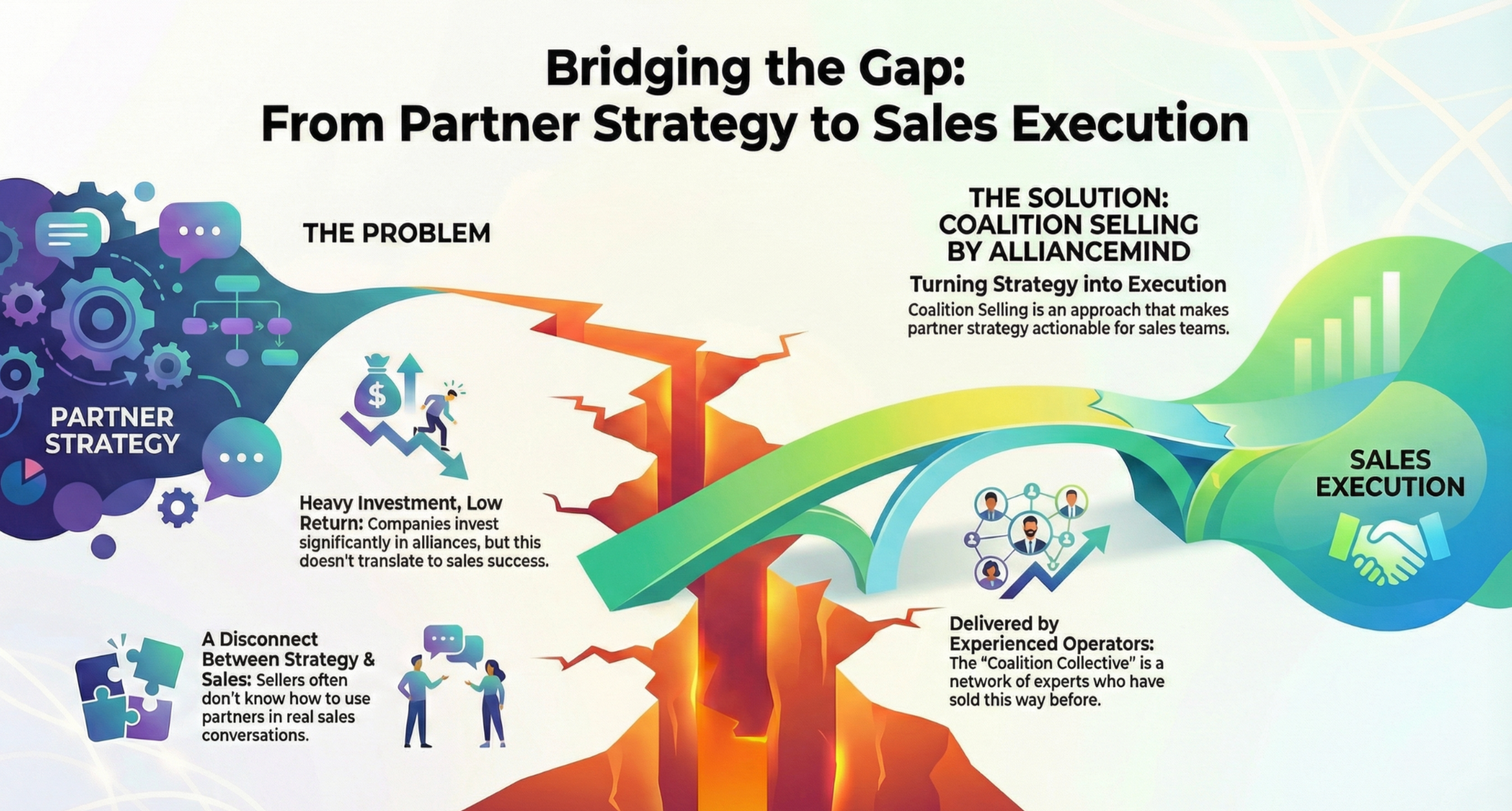
Our Elevator Pitch
Partner strategies are evolving, but they’re also getting harder to execute. Most companies invest heavily in alliances, yet sellers still don’t know how to use partners in real sales conversations. AllianceMind was built to close that gap. We turn partner strategy into a sales execution approach called Coalition Selling, delivered through the Coalition Collective, a network of experienced operators who have actually sold this way before.

Background: Sales Reels
Internal Sales Enablement
Sales Reels are short, focused enablement videos for AllianceMind CCMs. They explain how sellers think, how deals actually move, and where partners commonly misinterpret engagement and execution.
These are internal tools. Not marketing. Not client-facing. Sales Reels exist to sharpen judgment, reinforce execution discipline, and establish consistent language across AllianceMind programs.
Use Sales Reels to:
Prepare for partner conversations
Set and reset expectations
Understand seller behavior and incentives
Avoid overpromising or scope creep
Each Sales Reel is designed to be consumed quickly and revisited often. Watch before meetings, during onboarding, or when a partner conversation feels unclear.
This library will grow over time. Focus on recognizing patterns, not memorizing details.

Background: Big Picture Selling
Big Picture Selling starts with the customer’s reality, not the seller’s product.
Customers are trying to make an end-to-end business process work. That process spans multiple systems, teams, vendors, and partners. While sales conversations often focus on individual products, customers experience the problem as one continuous operating challenge.
Big Picture Selling is about understanding that full process. It requires situational awareness of how the pieces fit together, who is involved, and where handoffs, dependencies, and gaps exist. This understanding allows sellers and partners to engage with credibility, context, and relevance.
When teams align around the customer’s big picture, conversations shift from features to outcomes. Coalition Selling builds on this foundation by coordinating the vendors and partners already present in the customer’s environment, ensuring the story matches the reality the customer is managing.
Companies don’t buy products. They fix business processes.

Background: The Signal and the System
Ecosystem-Led Growth platforms have fundamentally changed how companies see their partner ecosystems.
Tools like Crossbeam and PartnerTap connect directly to participating companies’ CRMs and securely surface account-level overlap across partners. By matching accounts, customers, and pipeline signals, they give sales and partner teams visibility that simply did not exist before. Teams can now see where partners are already involved, where influence exists, and where co-sell opportunities may be possible.
This visibility is a major step forward.
But it also exposes a new reality.
As ELG platforms surface more overlap, they increase the number of partners, vendors, and sellers involved in the same accounts. Sales teams gain insight into who is present, but they are not given guidance on how to engage, who should lead, or how value and responsibility are shared. Signals appear faster than shared context can form.
The result is a new kind of complexity.
More data.
More partners.
More opportunity.
And more ambiguity.
This is the point where systems matter.
Market signals from platform ecosystems, hyperscalers, Agentic AI, and ELG platforms all point in the same direction. Enterprise selling is now multi-party by default. Visibility alone is not enough. Coordination, role clarity, and aligned narratives are required to turn signals into outcomes.
Coalition Selling is the system-level response. It provides the structure needed to interpret ELG signals, align partners around the customer’s operating reality, and coordinate multi-party engagement without improvisation.
ELG platforms reveal the network. Coalition Selling enables the motion.

Chapter 0: Why Coalition Selling Exists
Modern enterprise deals don’t close in isolation. They close inside ecosystems made up of sellers, partners, platforms, and customers, each with different incentives and timing. Most sales teams are still trained as if they sell alone. That gap is where deals stall.
Coalition Selling exists to replace solo selling with coordinated execution. It provides a practical way to understand who matters in a deal, when they matter, and how to engage them without slowing momentum or creating noise. The goal is not more partners. The goal is the right partners, activated at the right moment, for a specific outcome.
This chapter establishes the core mindset shift: selling is no longer about persuasion alone. It’s about orchestration. Every chapter that follows builds on this premise.

Chapter 1: From Content to Context
Traditional partner training focuses on content: slides, certifications, and generic enablement that increases cognitive load but doesn’t help sellers in live deals. Sales teams don’t struggle with information. They struggle with timing, judgment, and clarity in the moment.
Content to Context reframes enablement around real deal conditions. Instead of explaining what partners do, it shows when and why partner involvement matters within a customer’s broader business transformation. The focus shifts from product features to situational guidance tied to deal stage, customer intent, and execution risk.
By delivering the right context at the moment a deal needs it, sellers gain confidence, move faster, and engage partners with purpose. Context replaces guesswork. Clarity replaces noise. This is how complex ecosystems become usable in real sales motion.

Chapter 2: Why Coalition Selling™ Matters Now
Enterprise selling has shifted from isolated product transactions to ecosystem-led buying decisions. Customers now evaluate how vendors, partners, and platforms operate together to deliver transformation, not just individual capabilities.
As ecosystems expand, execution risk increases. Misaligned partners, unclear roles, and fragmented narratives slow deals and erode seller confidence. The challenge is no longer access to partners. It is coordination, timing, and accountability in live deals.
This chapter explains why Coalition Selling™ is now required. Coalition Selling™ is an execution framework designed to bring discipline to ecosystem-led selling by aligning participants around a shared deal strategy. It replaces ad hoc collaboration with structured engagement, clear roles, and situational relevance.
Coalition Selling™ turns ecosystem scale from a source of friction into a competitive advantage by enabling sellers to orchestrate complexity with confidence.

Chapter 3: Building the Coalition
Coalition Selling begins with intentional coalition design. Most partner motions fail because coalitions form reactively around personalities, existing relationships, or convenience instead of deal requirements. The result is too many voices, unclear roles, and increased friction for sellers.
This chapter explains how to build coalitions deliberately, based on customer context and deal stage rather than partner availability. It reframes coalition building as a discipline that prioritizes relevance, timing, and role clarity over participation volume. The objective is not to assemble the largest ecosystem, but the right one.
Building the coalition means defining who belongs in the deal, why they belong, and when they should engage. When done correctly, coalitions reduce complexity for sellers instead of adding to it. They create focus, preserve deal control, and establish trust early in the sales process.
Coalition Selling treats coalition formation as a strategic act. Every participant must earn their place by lowering risk, accelerating progress, or clarifying decisions. Anything else weakens the deal.

Chapter 4: Why Generic Alignment Fails in Real Deals
Generic partner alignment sounds good in theory but breaks down in live deals. Sellers don’t have time to interpret broad positioning, map vague value propositions, or guess how a partner fits a specific opportunity. When alignment isn’t concrete, it creates hesitation, not confidence.
In real sales motion, “we can help anywhere” is a liability. Sellers need partners who are easy to position, easy to explain, and clearly relevant to the customer’s current problem. Without that specificity, partner involvement increases cognitive load and slows momentum.
This chapter explains why successful partner engagement depends on focus, not flexibility. Coalition Selling replaces generic alignment with situational precision, ensuring partners show up with a defined role, at the right moment, for a clear outcome. That clarity is what earns trust and repeat use inside real deals.

Chapter 5: Managing Perceived Sales Risk
Sales decisions slow down when sellers sense risk, even if they don’t articulate it. In partner-led deals, risk is rarely about the solution itself. It’s about uncertainty. Unclear roles. Unproven partners. Extra coordination. Anything that threatens deal control, timing, or credibility raises friction.
Coalition Selling reframes partner engagement as a risk management exercise. The goal is not to add more people to a deal, but to reduce uncertainty for the seller. Partners earn trust by showing up with clarity. Clear value. Clear timing. Clear ownership. When partners create confusion or overreach, sellers disengage or stall rather than say no outright.
This chapter explains how perceived risk shows up in real deals, why sellers hesitate instead of rejecting partner help, and how disciplined coalition behavior lowers resistance. When risk is managed properly, sellers move faster, engage partners earlier, and keep deals in motion without losing control.

Chapter 6: The Role of the Partner Organization
Coalition Selling succeeds or fails based on the effectiveness of the internal partner organization. Sellers do not engage ecosystems directly. They engage through the structure, guidance, and discipline provided by their partner team.
This chapter defines the partner organization as an execution function, not a relationship hub. Its responsibility is to make partner involvement predictable, relevant, and low-risk for sellers. When partner teams fail to set clear engagement models, sellers experience ecosystems as chaotic, distracting, and unreliable.
The partner organization exists to absorb complexity on behalf of sellers. It decides which partners matter, when they should engage, and how they support specific deal moments. By enforcing role clarity and timing discipline, the organization reduces perceived sales risk and increases seller confidence.
When the partner organization operates correctly, sellers reuse it instinctively. When it does not, sellers avoid partners altogether. This chapter explains why partner organizations must function as operating systems for Coalition Selling, not optional support functions.
Chapter 7: The Pipeline Black Hole
Most deals don’t fail outright. They stall. The pipeline black hole is where opportunities lose momentum without a clear no, a clear next step, or a formal close. Sellers stay loosely engaged, partners wait for direction, and the deal slowly disappears.
This chapter explains why stalled pipeline is usually caused by execution friction rather than lack of interest. Poorly timed partner involvement, unclear ownership, and added cognitive load push sellers into delay mode. Instead of rejecting the deal, they deprioritize it.
Coalition Selling treats pipeline stall as a diagnostic signal. By identifying early warning signs and tightening engagement discipline, teams can either reestablish momentum or exit cleanly. The goal is clarity. Deals should move forward or close out, not linger indefinitely.

Chapter 8: Alignment with Reference Architecturess
Executive Technical Alignment starts before the deal, not during it.
This capability focuses on the proactive work required to ensure technical clarity before sales engagement begins. Partner organizations, product teams, and ecosystem leaders align on high-level reference architectures that define how solutions fit together, who owns what, and where value is created.
The objective is to eliminate technical ambiguity in live deals by doing the hard thinking upfront.
This approach enables teams to:
Establish reference architectures that reflect real-world customer environments.
Clarify partner roles, technical ownership, and commercial responsibility in advance.
Align product and partner teams on how solutions integrate and scale.
Enter customer conversations with confidence, consistency, and credibility.
When Executive Technical Alignment is done well, sales conversations move faster. Technical questions are answered cleanly. Partners operate from shared assumptions. Deals progress without late-stage confusion over architecture, roles, or economics.
The result is fewer surprises, stronger executive confidence, and a technical foundation that supports business outcomes from day one.

Market Signal: Workday Partner Announcement, 2025
Workday is used here as a market signal to help Coalition Collective Members understand how enterprise buyers expect complex solutions to come together.
The signal is not about selling Workday. It is about recognizing a buying pattern. Enterprise executives increasingly expect Finance, HR, and adjacent systems to operate as an integrated platform, supported by a coordinated ecosystem.
For CCMs, this signal reinforces a core responsibility: Do the technical and partner alignment work before the deal exists.
This includes understanding how products fit together, where partners add value, and how technical and commercial responsibilities are divided. When this work is done upfront, CCMs enter customer conversations with clarity and credibility. When it is not, confusion shows up late and damages trust.
Workday’s market position simply makes this expectation visible. CCMs who internalize this signal help coalitions move faster, align earlier, and avoid friction in live deals.

Market Signal: Hyperscalers Institutionalize Multi-Partner Selling
Hyperscalers have fundamentally changed how enterprise deals get done.
Cloud providers now operate as ecosystem orchestrators, requiring ISVs, services firms, and partners to co-sell, co-market, and transact through structured programs. Marketplaces, co-sell motions, and shared incentives are no longer optional. They are built into the sales process.
This shift introduces complexity that most sales teams are not trained to manage. Deals now involve multiple vendors, overlapping roles, shared economics, and external sales teams operating in parallel. What was once a two-party transaction has become a coordinated, multi-party motion.
For many sellers, the challenge is not cloud technology. It is knowing how to engage across vendors, align incentives, and navigate shared ownership without losing control of the deal.
This market signal reinforces a broader reality. As hyperscalers institutionalize ecosystem-led selling, success depends on structured coordination across partners. Coalition Selling exists to provide that structure, enabling teams to operate confidently inside increasingly complex, multi-vendor sales motions..
Contact us
Interested in working together? Fill out some info and we will be in touch shortly. We can’t wait to hear from you!